What is WTZ 100®?
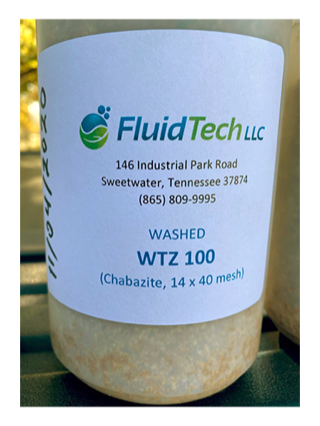
WTZ 100® is a natural chabazite zeolite — anhydrous sodium aluminosilicate (natural herschelite – sodium chabazite, CAS 1318-02-1) — supplied as dry granules and powders.
It is characterized by its high surface area, high cation exchange capacity (CEC), and physical durability. Its pozzolanic properties prove highly valuable in cementitious products, and its unique chemical and physical properties also allow for gas adsorption and water absorption/desorption, making it ideal for multiple industrial and environmental end-use applications.
The SDS lists its recommended uses as water filtration, sorbent, odor control/desiccant, and flow agent. It is not FDA approved for human consumption. Fluid Tech natural zeolite has no additives or materials that require special treatment; some Fluid Tech products, however, are treated to enhance their use for special applications.
Technical specifications
| Form | Granules & powders |
|---|---|
| Color | Reddish / tan (dry brightness 40) |
| Ring members | 8 |
| Crystal size | Less than 1 micron |
| Crystallinity | +90% |
| Density | 1.73 g/cm³ |
| Pore size | 4.1 by 3.7 Angstroms |
| Effective pore diameter | 4.3 Angstroms |
| Cavity size | 11.0 by 6.6 Angstroms |
| Total pore volume | .468 cm³/g |
| Surface area | 520 m²/g |
| Crystal void volume | .47 cm³/cm³ |
| Packing density | Approx. 40 – 44 lbs/ft³ |
| SiO₂/Al₂O₃ ratio | Approx. 4:1 |
| MOH's hardness | 4 – 5 |
| Moisture as packaged | Less than 20% by weight |
| pH of 1% dispersion | 8.5 |
| Stability | pH of 3 through 12 |
| Ion exchange capacity | 2.50 meq/g |
| Sorption capacity | >15 wt. % H₂O |
Typical properties as published on the Fluid Tech Ion Exchange Media page.
What is WTZ 100® made of?
WTZ 100® is 100% anhydrous sodium aluminosilicate (natural herschelite – sodium chabazite, CAS 1318-02-1), with sodium as the dominant cation. Typical chemical analysis, anhydrous basis:
| SiO₂ | 68.1 |
|---|---|
| Al₂O₃ | 18.59 |
| Fe₂O₃ | 2.84 |
| CaO | 0.27 |
| MgO | 0.75 |
| Na₂O | 8.32 |
| K₂O | 1.12 |
| Dominant cation | Na |
Exchange selectivities: Tl⁺ > Cs⁺ > K⁺ > Ag⁺ > Rb⁺ > NH₄⁺ > Pb²⁺ > Na⁺ = Ba²⁺ > Sr²⁺ > Ca²⁺, Li⁺
Final operator before Li⁺ is absent in the published series; order shown as published.
Exchange of heavy metal ions — weight percent of heavy metals retained in the anhydrous zeolite after ion exchange from a .10 mg/ml solution of AgNO₃, Pb(NO₃)₂, and CoSO₄, and a 0.025 mg/ml solution of CuSO₄, at the initial pH indicated for each solution:
| Ag (initial pH 5.30) | 21.85 wt% |
|---|---|
| Pb (initial pH 3.80) | 15.27 wt% |
| Cu (initial pH 3.43) | 3.17 wt% |
| Co (initial pH 2.91) | 2.82 wt% |
Data as published on the Fluid Tech Ion Exchange Media page for the anhydrous chabazite zeolite (the source labels the dataset under a supplier brand). First column shown as Ag per the source's own text (AgNO₃ solution) — the published table header prints "SiO₂".
What applications does WTZ 100® serve?
WTZ 100® is ideal for multiple industrial and environmental end-use applications, including radioactive waste control, aquaculture, and water filtration and purification.
- Radioactive waste control
- Water filtration & purification
- Aquaculture
- Cementitious products — pozzolanic properties
- Gas adsorption & water absorption/desorption
- Sorbent, odor control/desiccant, flow agent (per SDS recommended use)
Not FDA approved for human consumption.
When should you choose WTZ 100® vs WTZ 200®?
Choose WTZ 100® where its 520 m²/g surface area, 2.50 meq/g ion exchange capacity, abrasion resistance, and pozzolanic properties matter — it is an ideal water filtration media, stable from pH 3 through 12.
WTZ 200®, a clinoptilolite zeolite, is characterized instead by its light weight, a 1.85 meq/g ion exchange capacity, and thermal stability to 650 °C (1,202 °F). Its chemical composition and affinity for radionuclides make it a proven and highly effective media for nuclear remediation applications — including hazardous waste cleanup of arsenic and thallium — and it is also valued in gas separation and specialty desiccant markets.
Both grades are covered by the same Safety Data Sheet, and both serve radioactive waste control and water filtration and purification. Need help matching a grade to your waste stream? Ask our team.
Is WTZ 100® hazardous to handle?
WTZ 100® carries a GHS "Warning" signal word: it may be harmful if swallowed and may cause mild skin irritation, eye irritation, and respiratory irritation — avoid breathing dusts and wear eye/face protection, protective gloves, and a NIOSH-approved dust mask or respirator where dust occurs.
- Not combustible or flammable (NFPA: Health 1 · Flammability 0 · Reactivity 0)
- Not regulated as dangerous goods for transport (DOT, IATA, IMDG)
- Does not contain asbestos or fibrous zeolite minerals; may contain greater than 0.10% free silica (crystalline silica was not detected by X-ray diffraction analysis but may be present above the 0.10% notification level)
- Store in a cool, dry area; keep container closed; do not allow water to contact the product until time of use to preserve product utility
- No known adverse effects to the environment
Frequently asked questions
What is WTZ 100® made of?
WTZ 100® is a natural chabazite zeolite — anhydrous sodium aluminosilicate, natural herschelite (sodium chabazite), CAS 1318-02-1, 100% of the product. Its typical chemical analysis (anhydrous basis) is SiO₂ 68.1, Al₂O₃ 18.59, Fe₂O₃ 2.84, CaO 0.27, MgO 0.75, Na₂O 8.32, K₂O 1.12, with sodium as the dominant cation and a SiO₂/Al₂O₃ ratio of approximately 4:1. It does not contain asbestos or fibrous zeolite minerals.
What applications is WTZ 100® used for?
End-use applications include radioactive waste control, aquaculture, and water filtration and purification. Its chemical composition, high cation exchange capacity, and abrasion resistance make it an ideal water filtration media; its pozzolanic properties prove highly valuable in cementitious products; and its properties also allow for gas adsorption and water absorption/desorption. The SDS lists its recommended uses as water filtration, sorbent, odor control/desiccant, and flow agent. It is not FDA approved for human consumption.
What is the difference between WTZ 100® and WTZ 200®?
WTZ 100® is a chabazite zeolite with a 520 m²/g surface area, a 2.50 meq/g ion exchange capacity, abrasion resistance, pozzolanic properties, and stability from pH 3 through 12. WTZ 200® is a clinoptilolite zeolite characterized by its light weight, a 1.85 meq/g ion exchange capacity, thermal stability to 650 °C (1,202 °F), and an affinity for radionuclides that makes it a proven media for nuclear remediation, including hazardous waste cleanup of arsenic and thallium.
Is WTZ 100® hazardous to handle?
WTZ 100® carries a GHS "Warning" signal word: it may be harmful if swallowed and may cause mild skin, eye, and respiratory irritation, so avoid breathing dusts and wear eye/face protection, gloves, and a NIOSH-approved dust mask or respirator where dust occurs. The product is not combustible or flammable and is not regulated as dangerous goods for transport. Store in a cool, dry area with the container closed, and do not allow water to contact the product until time of use to preserve product utility.
In the technical record
Documents in the Technical Library that reference WTZ 100®:
- Removing Activated Cobalt at Salem Nuclear Station with FHA & WTZ 100
- Oak Ridge Process Waste Treatment Complex — Testing of New Ion-Exchange Media
- Hanford 105-K West Fuel Basin Cleanup and Decommissioning
Publication, testing, or permitting by a government laboratory, contractor, or agency does not constitute endorsement of any commercial product.
Scoping an ion exchange application?
Tell us about your waste stream and our team will help match the right media to your application.
Content reviewed August 2026 · WTZ 100/200 Safety Data Sheet FTL-080-0020, Revision 2 (January 18, 2020) · fluidtechllc.com Ion Exchange Media product page.