
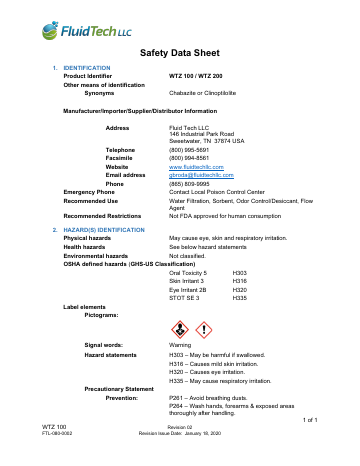
The linked PDF (Revision 2) is the authoritative document. The text below reproduces its contents for accessibility and reference. If anything differs, rely on the PDF, and confirm the revision date is current (within 3 years) before relying on this sheet.
1. Identification
- Product identifier
- WTZ 100® / WTZ 200®
- Synonyms
- Chabazite or Clinoptilolite
- Recommended use
- Water Filtration, Sorbent, Odor Control/Desiccant, Flow Agent.
- Recommended restrictions
- Not FDA approved for human consumption.
- Manufacturer
- Fluid Tech LLC, 146 Industrial Park Road, Sweetwater, TN 37874, USA
- Telephone
- (423) 271-6505 · Fax (800) 994-8561
- Phone
- (865) 809-9995
- Emergency phone
- Contact Local Poison Control Center
- Website / email
- www.fluidtechllc.com · gbroda@fluidtechllc.com
2. Hazard(s) Identification
Signal word: Warning
Hazard classification (GHS-US): Oral Toxicity 5 (H303); Skin Irritant 3 (H316); Eye Irritant 2B (H320); STOT SE 3 (H335)
Physical hazards: May cause eye, skin and respiratory irritation.
Environmental hazards: Not classified.
Hazard statements: H303 – May be harmful if swallowed. H316 – Causes mild skin irritation. H320 – Causes eye irritation. H335 – May cause respiratory irritation.
Precautionary statements
- Prevention
- P261 – Avoid breathing dusts. P264 – Wash hands, forearms & exposed areas thoroughly after handling. P280 – Wear eye/face protection & protective gloves. Wear safety glasses or chemical goggles. Wear plastic, rubber or cotton gloves. Refer to 29 CFR 1910.133 or European Standard EN166. P284 – Wear respiratory protection. Use NIOSH approved dust mask or respirator where dust occurs. Refer to 29 CFR 1910.134 or European Standard EN149. P285 – In case of inadequate ventilation, wear respiratory protection.
- Response
- P301+P312 – IF SWALLOWED: Call a poison center or doctor if you feel unwell. P302+P352 – IF ON SKIN: Wash with plenty of soap and water. P332+P313 – If skin irritation persists, get medical advice/attention. P304+P341 – IF INHALED: If breathing is difficult, remove victim to fresh air and keep at rest in a position comfortable for breathing. P304+P312 – IF INHALED: Call a poison center or doctor if you feel unwell. P305+P351+P338 – IF IN EYES: Rinse cautiously with water for several minutes. Remove contact lenses, if present and easy to do. Continue rinsing.
- Storage
- None.
- Disposal
- P501 – Dispose of contents/container in accordance with local, regional, national and international regulations.
- Hazards not otherwise classified (HNOC)
- May contain greater than 0.10% free silica. Crystalline silica was not detected by X-Ray Defraction Analysis but may be present above the notification level of 0.10%. (Crystalline silica is considered a hazard by inhalation. During October, 1996, IARC reviewed the literature for polymorphs of crystalline silica and determined that there is sufficient evidence in humans for the carcinogenicity of inhaled crystalline silica in the form of quartz or cristobolite from occupational sources.) Does not contain asbestos or fibrous zeolite minerals.
- Supplemental information
- Unknown Acute Toxicity (GHS-US): No data available.
3. Composition / Information on Ingredients
| Chemical name | Common name and synonyms | CAS number | Percent |
|---|---|---|---|
| Anhydrous Sodium Aluminosilicate | Natural Herschelite – Sodium Chabazite | 1318-02-1 | 100 |
4. First-Aid Measures
- Inhalation
- Move subject to fresh air. Rinse mouth & nasal passages with water. If irritation persists or worsens, seek medical attention.
- Skin contact
- Rinse with water. Use hand moisturizer to sooth dryness. If irritation persists or worsens, seek medical attention.
- Eye contact
- Remove contact lenses. Flush eyes with water for 15 minutes. If irritation persists or worsens, seek medical attention.
- Ingestion
- Move subject to fresh air. Rinse mouth & nasal passages with water. If irritation persists or worsens, seek medical attention.
- Symptoms/injuries after ingestion
- May cause dry cough, slight nausea.
- Symptoms/injuries after skin contact
- Causes dry, rough skin.
- Symptoms/injuries after eye contact
- Causes eye irritation, potential corneal scratching.
- Symptoms/injuries after inhalation
- May cause dry cough.
- Notes to physicians
- Fluid Tech LLC natural zeolite has no additives or materials that require special treatment. Some Fluid Tech LLC products, however, are treated to enhance their use for special applications.
5. Fire-Fighting Measures
- Suitable extinguishing media
- Not applicable.
- Unsuitable extinguishing media
- Not applicable.
- Specific hazards arising from the chemical
- The product is not combustible or flammable.
- Special protective equipment and precautions for firefighters
- Not applicable.
- Fire-fighting equipment/instructions
- In case of fire: Evacuate area. In case of fire and/or explosion do not breathe fumes.
6. Accidental Release Measures
- Personal precautions, protective equipment and emergency procedures
- General: No known adverse effects to the environment. Avoid breathing dust. Wear eye/face protection & protective gloves. Wear respiratory protection. Refer to Section 2 – Hazards Identification, Precautionary Statements.
- For emergency personnel
- Protective Equipment: Use appropriate personal protection equipment (PPE). Emergency Procedures: Ventilate area.
- For non-emergency personnel
- Protective Equipment: Use appropriate personal protection equipment (PPE). Emergency Procedures: Evacuate unnecessary personnel.
- Methods and materials for containment and cleaning up
- Containment: Sweep, scoop, or vacuum discharged material. Clean-Up: Landfill according to local, state, national and international regulations.
- Environmental precautions
- There are no known adverse effects to the environment.
7. Handling and Storage
- Precautions for safe handling
- Keep container closed when not in use. Keep out of the reach of children.
- Conditions for safe storage, including any incompatibilities
- Store in a cool, dry area. Do not allow water to contact the product until time of use to preserve product utility. Keep container closed when not in use. Protect containers from abuse.
- Hygiene measures
- Handle in accordance with good industrial hygiene and safety procedures. Wash hands with mild soap and water before eating, drinking or smoking and again when leaving work.
8. Exposure Controls / Personal Protection
| Exposure limit | Value |
|---|---|
| USA ACGIH | Values have not been established |
| Recommended threshold limit | Ceiling Limit = 15 mg/m³ total dust; 5 mg/m³ Respirable Fraction |
| Exposure analysis method | Respirable Sampler or Midget Impinger. See: J. Am. Ind. Hyg. Assoc., 28:554 (1967) |
- Appropriate engineering controls
- Ensure all national/local regulations are observed.
- Personal protective equipment
- Wear eye/face protection, protective gloves and respiratory protection.
- Eye protection
- Wear safety glasses or chemical goggles.
- Hand protection
- Wear plastic, rubber or cotton gloves.
- Respiratory protection
- If exposure limits are exceeded or irritation is experienced, wear NIOSH approved respiratory protection.
- Thermal hazard protection
- N/A
9. Physical and Chemical Properties
Properties are reported separately for the two zeolite grades covered by this SDS: chabazite (WTZ 100®) and clinoptilolite (WTZ 200®).
| Property | Chabazite | Clinoptilolite |
|---|---|---|
| Appearance | Dry Granules & Powders | Dry Granules & Powders |
| Physical state | Pulverized Rock | Pulverized Rock |
| Color | Yellowish, Reddish, Tan | White to Off-White, Greenish |
| Odor | Odorless | Odorless |
| Odor threshold | No Threshold | No Threshold |
| pH | Not Applicable (Aqueous Liquids Only) | Not applicable. |
| Melting point/freezing point | Not applicable / No Data Available | 1800 °F / No Data Available |
| Flammability limit – lower (%) | Non-flammable. | Non-flammable. |
| Flammability limit – upper (%) | Non-flammable. | Non-flammable. |
| Relative density | No Data Available | No Data Available |
| Bulk density | No Data Available | No Data Available |
| Solubility (water) | Negligible | 0 |
| Auto-ignition temperature | No Data Available | No Data Available |
| Decomposition temperature | No Data Available | No Data Available |
| Specific gravity | N/A (Liquids Only) | 2.2 – 2.4 |
Initial boiling point/range, flash point, evaporation rate, flammability (solid, gas), upper/lower flammability or explosive limits, explosive limits (upper/lower), vapor pressure, vapor density, dynamic viscosity @ 20 °C and percent volatile: not applicable for both grades. Other information: none available. See PDF for the complete property table.
10. Stability and Reactivity
- Reactivity
- Products are not considered flammable or combustible.
- Chemical stability
- Stable. No stabilizers needed. No safety issues.
- Conditions to avoid
- N/A
- Incompatible materials
- No materials to avoid.
- Hazardous decomposition products
- N/A
- NFPA hazard ratings
- Health: 1 · Flammability: 0 · Reactivity: 0 · Special Hazard: None
11. Toxicological Information
| Route | Symptoms – Low Exposure | Symptoms – Severe Exposure |
|---|---|---|
| Inhalation | Respiratory irritation | Shortness of breath |
| Skin contact | Dry skin | Chapping |
| Eye contact | Itchy, irritated eyes | Corneal abrasions |
| Ingestion | Dry cough | Gagging |
- Acute toxicity
- Not Classified.
- Skin corrosion/irritation
- See “Symptoms” above.
- Serious eye damage/eye irritation
- See “Symptoms” above.
- Respiratory sensitization
- See “Symptoms” above.
- Skin sensitization
- See “Symptoms” above.
- Germ cell mutagenicity
- No data available to indicate product or any components present at greater than 0.1% are mutagenic or genotoxic.
- Carcinogenicity — IARC
- Not Listed as potential carcinogen in IARC Monographs.
- Carcinogenicity — OSHA
- Not Listed as potential carcinogen by OSHA (29 CFR 1910.1001-1050).
- Carcinogenicity — NTP
- Not Listed on NTP Report on Carcinogens.
- Reproductive toxicity
- This product is not expected to cause reproductive or developmental effects.
- Specific target organ toxicity – single exposure
- May cause respiratory irritation.
- Specific target organ toxicity – repeated exposure
- Undocumented.
- Aspiration hazard
- Not available.
- Chronic effects
- Prolonged inhalation may be harmful.
12. Ecological Information
- Ecotoxicity
- No data available. None of the ingredients are classified as a marine pollutant.
13. Disposal Considerations
Refer to “40 CFR Protection of Environment Parts 260-299” for complete waste disposal regulations. Consult your local, state or federal environmental protection agency before disposing of any chemicals.
- Disposal instructions
- Collect and reclaim or dispose in sealed containers at licensed waste disposal site. Dispose of contents/container in accordance with local/regional/national/international regulations.
- Local disposal regulations
- Dispose in accordance with all applicable regulations.
- Hazardous waste code
- The waste code should be assigned in discussion between the user, the producer and the waste disposal company.
- Waste from residues / unused products
- Material should be recycled if possible. Empty containers or liners may retain some product residues. This material and its container must be disposed of in a safe manner (see: Disposal instructions). Dispose of in accordance with local regulations. Can be landfilled, when in compliance with local regulations.
- Contaminated packaging
- Empty containers should be taken to an approved waste handling site for recycling or disposal. Since emptied containers may retain product residue, follow label warnings even after container is emptied.
14. Transport Information
- Land (DOT)
- Not regulated as dangerous goods.
- Canadian TDG
- Not restricted.
- Air (IATA)
- Not regulated as dangerous goods.
- Sea (IMDG)
- Not regulated as dangerous goods.
- Transport in bulk (MARPOL 73/78 Annex II / IBC Code)
- Not applicable.
- DOT shipping name
- Non-Hazardous for Transport
- Hazard symbols
- None
15. Regulatory Information
United States
- TSCA inventory
- All components of this product are not listed on the U.S. Toxic Substances Control Act Chemical Inventory or are exempted from listing because a Low Volume or Polymer Exemption has been granted in accordance with 40 CFR 723.50.
- OSHA specifically regulated substances (29 CFR 1910.1001-1050)
- Not listed.
- CERCLA hazardous substance list (40 CFR 302.4)
- None.
- SARA hazard categories
- Immediate Hazard – No; Delayed Hazard – No; Fire Hazard – No; Pressure Hazard – No; Reactivity Hazard – No.
- SARA 302 extremely hazardous substance
- Not listed.
- SARA 304 emergency release notification
- Not regulated.
- SARA 311/312 hazardous chemical
- Yes.
- SARA 313 (TRI reporting)
- Not regulated.
- California Prop 65
- There are no chemicals present known to the State of California to cause cancer or reproductive toxicity.
- Clean Air Act (CAA) Section 112 HAPs list
- Not regulated.
- Clean Air Act (CAA) Section 112(r) accidental release prevention (40 CFR 68.130)
- Not regulated.
- Safe Drinking Water Act (SDWA)
- Not regulated.
- EPA RCRA hazardous waste classification
- If product becomes a waste, it does NOT meet the criteria of a hazardous waste as defined by the US EPA.
International
- CPR (Canadian Controlled Products Regulations)
- This product has been classified in accordance with the hazard criteria of the Controlled Products Regulations and the SDS contains all the information required by the Controlled Products Regulations. WHMIS Classification: Not controlled.
- IDL (Canadian Ingredient Disclosure List)
- Components of this product identified by CAS number and listed on the Canadian Ingredient Disclosure List are shown in Section 3.
- DSL/NDSL (Canadian Domestic / Non-Domestic Substances List)
- Components of this product identified by CAS number are not listed on the DSL or NDSL, or are otherwise in compliance with the New Substances Notification (NSN) regulations. Only ingredients classified as “hazardous” are listed in Section 2, unless otherwise indicated.
- EINECS (European Inventory of Existing Commercial Chemical Substances)
- Components of this product identified by CAS numbers are on the European Inventory of Existing Commercial Chemical Substances unless indicated as “not found”.
- WGK water quality index
- nwg
- VbK index
- Not Applicable
16. Other Information
- Issue date
- June 5, 2015
- Revision date
- November 6, 2018; January 18, 2020
- Version
- 01; 02
- Further information
- This document has been prepared in accordance with the SDS requirements of the OSHA Hazard Communication Standard 29 CFR 1910.1200.
GHS full-text phrases
- Oral Toxicity 5 — Acute Toxicity, Oral – Category 5
- Skin Irritant 3 — Skin Corrosion/Irritation – Category 3
- Eye Irritant 2B — Serious Eye Damage/Irritation – Category 2B
- STOT SE 3 — Respiratory tract irritation – Category 3
Notes & full R-phrase text
- R-phrases
- R20: Harmful by inhalation. R36, R37, R38: Irritating to eyes, respiratory system and skin.
- HMIS III ratings
- Health: 1 · Flammability: 0 · Physical Hazard: 0 · Personal Safety Equipment: E
- Definitions
- * = Chronic Health Hazard; 0 = Insignificant; 1 = Slight; 2 = Moderate; 3 = High; 4 = Extreme. E = Safety Glasses, Gloves, Respirator.
Revision history
- Revision 1 (November 6, 2018) — Version 01
- Revision 2 (January 18, 2020) — Updated Section 1, address; added WTZ 200® to Product Identifier
Disclaimer
The information in the sheet was written based on the best knowledge and experience currently available. MANUFACTURER DISCLAIMER: The information given within this SDS is correct to the best of our knowledge, information and belief at the date of its revision and publication. However, the manufacturer makes no representation, warranty or guarantee as to its accuracy, reliability or completeness, nor assumes any liability for its use. It is the user's responsibility to confirm in advance that the information is current, applicable and suitable to their circumstances for each particular use. No representative of ours has authority to waive this provision. Please call for document accuracy if the revision date has exceeded 3 years.