
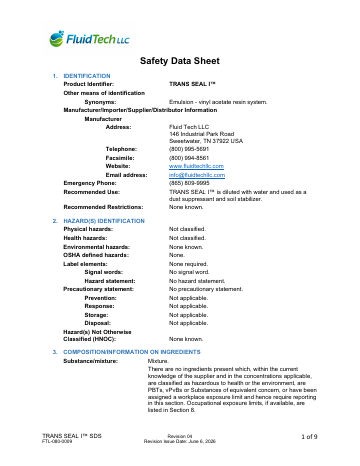
The linked PDF (Revision 4) is the authoritative document. The text below reproduces its contents for accessibility and reference. If anything differs, rely on the PDF, and confirm the revision date is current (within 3 years) before relying on this sheet.
1. Identification
- Product identifier
- TRANS SEAL I™
- Synonyms
- Emulsion — vinyl acetate resin system.
- Recommended use
- TRANS SEAL I™ is diluted with water and used as a dust suppressant and soil stabilizer.
- Recommended restrictions
- None known.
- Manufacturer
- Fluid Tech LLC, 146 Industrial Park Road, Sweetwater, TN 37922, USA
- Telephone
- (800) 995-5691 · Fax (800) 994-8561
- Emergency phone
- (865) 809-9995
- Website / email
- www.fluidtechllc.com · info@fluidtechllc.com
2. Hazard(s) Identification
Signal word: No signal word.
Hazard classification: Physical hazards: Not classified. Health hazards: Not classified. Environmental hazards: None known. OSHA defined hazards: None.
Hazard statements: No hazard statement.
Label elements & precautionary statements
- Label elements
- None required.
- Precautionary statement
- No precautionary statement.
- Hazard(s) Not Otherwise Classified (HNOC)
- None known.
Prevention, Response, Storage and Disposal precautionary statements: Not applicable.
3. Composition / Information on Ingredients
- Substance / mixture
- Mixture.
There are no ingredients present which, within the current knowledge of the supplier and in the concentrations applicable, are classified as hazardous to health or the environment, are PBTs, vPvBs or Substances of equivalent concern, or have been assigned a workplace exposure limit and hence require reporting in this section. Occupational exposure limits, if available, are listed in Section 8.
4. First-Aid Measures
- Inhalation
- Remove victim to fresh air and keep at rest in a position comfortable for breathing. Get medical attention if symptoms occur.
- Skin contact
- Flush contaminated skin with plenty of water. Remove contaminated clothing and shoes. Get medical attention if symptoms occur.
- Eye contact
- Immediately flush eyes with plenty of water, occasionally lifting the upper and lower eyelids. Check for and remove any contact lenses. Get medical attention if irritation occurs.
- Ingestion
- Wash out mouth with water. Remove victim to fresh air and keep at rest in a position comfortable for breathing. If material has been swallowed and the exposed person is conscious, give small quantities of water to drink. Do not induce vomiting unless directed to do so by medical personnel. Get medical attention if symptoms occur.
- Most important symptoms/effects, acute and delayed
- None known.
- Indication of immediate medical attention and special treatment needed
- Provide general supportive measures and treat symptomatically. Keep victim under observation. Contact poison treatment specialist if large quantities have been ingested or inhaled.
- General information
- Ensure that medical personnel are aware of the material(s) involved and take precautions to protect themselves. IF exposed or concerned: Get medical advice/attention. No hazards which require special first aid measures. No action shall be taken involving any personal risk without suitable training.
5. Fire-Fighting Measures
- Suitable extinguishing media
- Use a fire-extinguishing media appropriate for surrounding materials.
- Unsuitable extinguishing media
- None known.
- Specific hazards arising from the chemical
- In a fire or if heated, a pressure increase will occur, and the container may burst.
- Hazardous thermal decomposition products
- Decomposition products may include the following materials: carbon oxides.
- Special protective equipment and precautions for firefighters
- Promptly isolate the scene by removing all persons from the vicinity of the incident if there is a fire. No action shall be taken involving any personal risk or without suitable training must be worn in case of fire.
- Fire fighting equipment/instructions
- Fire-fighters should wear appropriate protective equipment and self-contained breathing apparatus (SCBA) with a full face-piece operated in positive pressure mode.
6. Accidental Release Measures
- Personal precautions, protective equipment and emergency procedures
- No action shall be taken involving any personal risk or without suitable training. Evacuate surrounding areas. Keep unnecessary and unprotected personnel from entering. Do not touch or walk-through spilled material. Put on appropriate personal protective equipment. If specialized clothing is required to deal with the spillage, take note of any information in Section 8 on suitable and unsuitable materials.
- Methods and materials for containment and cleaning up
- Stop the flow of material. Large Spills: Stop leak if without risk. Move containers from spill area. Prevent entry into sewers, water courses, basements or confined areas. Wash spillages into an effluent treatment plant or proceed as follows: Contain and collect spillage with non-combustible, absorbent material e.g., sand, earth, vermiculite or diatomaceous earth and place in appropriate container for disposal according to local regulations. Small Spills: Stop leak if without risk. Move containers from spill area. Dilute with water and mop up if water-soluble. Alternatively, or if water-insoluble, absorb with an inert dry material and place in appropriate container for disposal according to local regulations. Note: see Section 1 of SDS for emergency contact information and Section 13 of SDS for waste disposal.
- Environmental precautions
- Avoid dispersal of spilled material and runoff and contact with soil, waterways, drains and sewers. Inform the relevant authorities if the product has caused environmental pollution (sewers, waterways, soil or air).
7. Handling and Storage
- Precautions for safe handling
- Obtain special instructions before use. Put on appropriate personal protective equipment (see Section 8 of SDS). Eating, drinking and smoking should be prohibited in areas where this material is handled, stored and processed. Workers should wash hands and face before eating, drinking and smoking. Remove contaminated clothing and protective equipment before entering eating areas. See also Section 8 for additional information on hygiene measures.
- Conditions for safe storage, including any incompatibilities
- Store in accordance with local regulations. Store in original container protected from direct sunlight in a dry, cool and well ventilated area, away from incompatible materials (see Section 10 of SDS) and food and drink. Keep container tightly closed and sealed until ready for use. Containers that have been opened must be carefully resealed and kept upright to prevent leakage. Do not store in unlabeled containers. Use appropriate containment to avoid environmental contamination.
8. Exposure Controls / Personal Protection
- Occupational exposure limits
- None.
- Biological limit values
- No biological exposure limits noted for the ingredient(s).
- Exposure guidelines
- If this product contains ingredients with exposure limits, personal, workplace atmosphere or biological monitoring may be required to determine the effectiveness of the ventilation or other control measures and/or the necessity to use respiratory protective equipment. Reference should be made to appropriate monitoring standards. Reference to national guidance documents for methods for the determination of hazardous substances will also be required.
- Appropriate engineering controls
- No special ventilation requirements. Good general ventilation should be sufficient to control worker exposure to airborne contaminants. If this product contains ingredients with exposure limits, use process enclosures, local exhaust ventilation or other engineering controls to keep worker exposure below any recommended or statutory limits. Emissions from ventilation or work process equipment should be checked to ensure they comply with the requirements of environmental protection legislation. In some cases, fume scrubbers, filters or engineering modifications to the process equipment will be necessary to reduce emissions to acceptable levels.
- Eye/face protection
- Safety eyewear complying with an approved standard should be used when a risk assessment indicates this is necessary to avoid exposure to liquid splashes, mists, gases or dusts. If contact is possible, the following protection should be worn, unless the assessment indicates a higher degree of protection: safety glasses with side-shields.
- Hand protection
- Chemical-resistant, impervious gloves complying with an approved standard should be worn at all times when handling chemical products if a risk assessment indicates this is necessary.
- Body protection
- Personal protective equipment for the body should be selected based on the task being performed and the risks involved and should be approved by a specialist before handling this product.
- Other skin protection
- Appropriate footwear and any additional skin protection measures should be selected based on the task being performed and the risks involved and should be approved by a specialist before handling this product.
- Respiratory protection
- If engineering controls do not maintain airborne concentrations below recommended exposure limits (where applicable) or to an acceptable level (in countries where exposure limits have not been established), an approved respirator must be worn. Respirator selection must be based on known or anticipated exposure levels, the hazards of the product and the safe working limits of the selected respirator.
- General hygiene considerations
- Wash hands, forearms and face thoroughly after handling chemical products, before eating, smoking and using the lavatory and at the end of the working period. Appropriate techniques should be used to remove potentially contaminated clothing. Wash contaminated clothing before reusing. Ensure that eyewash stations and safety showers are close to the workstation location.
9. Physical and Chemical Properties
- Physical state
- Liquid
- Color
- Opaque, white
- Odor
- Acetic
- Odor threshold
- Not available.
- pH
- 4.0 – 5.5 @ 25 °C (77 °F)
- Melting point/freezing point
- 0 °C (32 °F)
- Boiling point
- 100 °C (212 °F)
- Flash point
- Not determined.
- Evaporation rate
- 1 (n-Butyl acetate = 1)
- Flammability (solid, gas)
- Not available.
- Vapor pressure
- 17.5 mm Hg @ 20 °C (68.00 °F)
- Vapor density
- 0.62 [Air = 1]
- Relative density
- 1.08 – 1.10
- Solubility (water)
- Miscible
- Auto-ignition temperature
- Not applicable.
- Viscosity (dynamic)
- Not available.
- Other information
- This SDS is not to be used as a specification sheet.
Upper/lower flammability and explosive limits: Not applicable. Solubility(ies), partition coefficient (n-octanol/water), and decomposition temperature: Not available. See PDF for the complete property table.
10. Stability and Reactivity
- Reactivity
- The product is stable and non-reactive under normal conditions of use, storage and transport.
- Chemical stability
- The product is stable under normal conditions.
- Possibility of hazardous reactions
- No dangerous or hazardous reactions known under conditions of normal use.
- Conditions to avoid
- Strong oxidizer.
- Incompatible materials
- The product is reactive or incompatible with oxidizing materials, and acids.
- Hazardous decomposition products
- Decomposition products may include carbon oxides.
11. Toxicological Information
Information on likely routes of exposure
- Inhalation
- Not available.
- Skin contact
- Not available.
- Eye contact
- Not available.
- Ingestion
- Not available.
Acute toxicity
- Skin corrosion/irritation
- No known significant effects or critical hazards.
- Serious eye damage/eye irritation
- No known significant effects or critical hazards.
- Respiratory sensitization
- This product is not expected to cause respiratory sensitization.
- Skin sensitization
- This product is not expected to cause skin sensitization.
- Germ cell mutagenicity
- No data available to indicate product or any components present at greater than 0.1% are mutagenic or genotoxic.
- Carcinogenicity
- Not available.
- Reproductive toxicity
- Not available.
- Specific target organ toxicity – single exposure
- Not available.
- Specific target organ toxicity – repeated exposure
- Not available.
- Aspiration hazard
- Not available.
- Chronic effects
- No known significant effects or critical hazards.
12. Ecological Information
- Ecotoxicity
- Not expected to be harmful to aquatic organisms. The product is not classified as environmentally hazardous. However, this does not exclude the possibility that large or frequent spills can have a harmful or damaging effect on the environment.
- Persistence and degradability
- No data available.
- Bio-accumulative potential
- No data available.
- Mobility in soil
- No data available.
- Other adverse effects
- No other adverse environmental effects (e.g., ozone depletion, photochemical ozone creation potential, endocrine disruption, global warming potential) are expected from this component. An environmental hazard cannot be excluded in the event of unprofessional handling or disposal. Not expected to be harmful to aquatic organisms.
13. Disposal Considerations
- Disposal instructions
- The generation of waste should be avoided or minimized wherever possible. Collect and reclaim or dispose in sealed containers at licensed waste disposal site. Dispose of contents/container in accordance with local/regional/national/international regulations.
- Local disposal regulations
- Dispose in accordance with all applicable regulations.
- Hazardous waste code
- The waste code should be assigned in discussion between the user, the producer and the waste disposal company.
- Waste from residues and unused products
- Material should be recycled if possible. Empty containers or liners may retain some product residues. This material and its container must be disposed of in a safe manner (see disposal instructions). Dispose of in accordance with local regulations. Can be landfilled, when in compliance with local regulations.
- Contaminated packaging
- Empty containers should be taken to an approved waste handling site for recycling or disposal. Since emptied containers may retain product residue, follow label warnings even after container is emptied.
14. Transport Information
The data provided in this section is for information only and may not be specific to your package size or mode of transport. You will need to apply the appropriate regulations to properly classify your shipment for transportation.
- DOT
- Not regulated as dangerous goods.
- IATA
- Not regulated as dangerous goods.
- IMDG
- Not regulated as dangerous goods.
- Transport in bulk (Annex II of MARPOL 73/78 and the IBC Code)
- Not applicable.
15. Regulatory Information
US federal regulations
- TSCA – Chemical Export Notification (TSCA 12(b))
- None required.
- TSCA – Final Significant New Use Rules (TSCA 5(a)2)
- Not listed.
- TSCA – Proposed Significant New Use Rules (TSCA 5(a)2)
- Not listed.
- TSCA – Substances Consent Order (TSCA 5(e))
- Not listed.
- TSCA Inventory (TSCA 8b)
- All components are listed or exempted.
- OSHA Specifically Regulated Substances (29 CFR 1910.1001-1050)
- Not listed.
- Clean Air Act (CAA) Section 112 Hazardous Air Pollutants (HAPs) List
- Not regulated.
- Clean Air Act (CAA) Section 112(r) Accidental Release Prevention (40 CFR 68.130)
- Not regulated.
- Safe Drinking Water Act (SDWA)
- Not regulated.
US state regulations
- US. California Proposition 65
- Components ≥0.1% are NOT known to be associated with carcinogenic effects.
International inventories
| Country or region | Inventory name | On inventory |
|---|---|---|
| Australia | Australian Inventory of Chemical Substances (AICS) | Yes |
| Canada | Domestic Substances List (DSL) | Yes |
| China | Inventory of Existing Chemical Substances in China (IECSC) | Yes |
| Japan | Inventory of Existing and New Chemical Substances (ENCS) | Yes |
| Korea | Existing Chemicals List (ECL) | Yes |
| New Zealand | New Zealand Inventory | Yes |
| Philippines | Philippine Inventory of Chemicals and Chemical Substances (PICCS) | Yes |
| Taiwan | Taiwan Chemical Substance Inventory (TCSI) | Yes |
| United States & Puerto Rico | Toxic Substances Control Act (TSCA) Inventory | Yes |
A "Yes" indicates that all components of this product comply with the inventory requirements administered by the governing country(s) or are exempted.
- Canada – Workplace Hazardous Materials Information System (WHMIS)
- Not controlled.
- Canada – Canadian NPRI
- None required.
- Canada – CEPA Toxic Substances
- None required.
16. Other Information
- HMIS® III ratings (U.S.A.)
- Health: 0 · Flammability: 0 · Physical hazards: 0
- Full text of abbreviated H statements
- Not applicable.
- Issue date
- May 15, 2015
- Revision date
- March 22, 2022
- Version
- 02
- Further information
- Not available.
Caution: HMIS® ratings are based on a 0-4 rating scale, with 0 representing minimal hazards or risks, and 4 representing significant hazards or risks. HMIS® is a registered mark of the National Paint & Coatings Association (NPCA). The customer is responsible for determining the PPE code for this material.
Revision history
- Revision 1 — Composition/Information on Ingredients: ingredients
- Revision 2 — Physical & Chemical Properties, multiple properties; Regulatory Information for United States
- Revision 3 — Address change, audit and format updates
- Revision 4 — Changes to Section 15 and 16
Disclaimer
The information in this sheet was written based on the best knowledge and experience currently available. The information given within this SDS is correct to the best of our knowledge, information and belief at the date of its revision and publication. However, the manufacturer makes no representation, warranty or guarantee as to its accuracy, reliability or completeness, nor assumes any liability for its use. It is the user's responsibility to confirm in advance that the information is current, applicable and suitable to their circumstances for each particular use. No representative of ours has authority to waive this provision. Please call for document accuracy if the revision date has exceeded 3 years.