
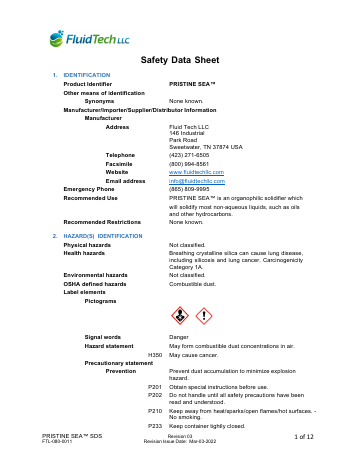
The linked PDF (Revision 3) is the authoritative document. The text below reproduces its contents for accessibility and reference. If anything differs, rely on the PDF, and confirm the revision date is current (within 3 years) before relying on this sheet.
1. Identification
- Product identifier
- PRISTINE SEA™
- Synonyms
- None known.
- Recommended use
- PRISTINE SEA™ is an organophilic solidifier which will solidify most non-aqueous liquids, such as oils and other hydrocarbons.
- Recommended restrictions
- None known.
- Manufacturer
- Fluid Tech LLC, 146 Industrial Park Road, Sweetwater, TN 37874, USA
- Telephone
- (423) 271-6505 · Fax (800) 994-8561
- Emergency phone
- (865) 809-9995
- Website / email
- www.fluidtechllc.com · info@fluidtechllc.com
2. Hazard(s) Identification
Signal word: Danger
Hazard classification: Health — Carcinogenicity (Category 1A). Physical — Not classified. Environmental — Not classified. OSHA defined hazards — Combustible dust.
Hazard statements: May form combustible dust concentrations in air. (H350) May cause cancer.
Precautionary statements
- Prevention
- Prevent dust accumulation to minimize explosion hazard. (P201) Obtain special instructions before use. (P202) Do not handle until all safety precautions have been read and understood. (P210) Keep away from heat/sparks/open flames/hot surfaces. — No smoking. (P233) Keep container tightly closed. (P240) Ground/bond container and receiving equipment. (P264) Wash thoroughly after handling. (P280) Wear protective gloves/protective clothing/eye protection/face protection.
- Response
- (P308 + P313) If exposed or concerned: Get medical advice/attention. (P362) Take off contaminated clothing and wash before reuse. (P370 + P378) In case of fire: Use appropriate media to extinguish.
- Storage
- (P405) Store locked up.
- Disposal
- (P501) Dispose of contents/container (in accordance with related regulations).
- Hazard(s) not otherwise classified (HNOC)
- WARNING! May form combustible dust concentrations in air (during processing). Material can be slippery when wet.
- Supplemental information
- None.
3. Composition / Information on Ingredients
| Chemical name | CAS number | Percent |
|---|---|---|
| Quaternary Ammonium Compounds, Bis (hydrogenated Tallow Alkyl) dimethyl, Salts with Bentonite | 68953-58-2 | 87 – 90 |
| Quartz | 14808-60-7 | < 3 |
A specific chemical identity and/or percentage of composition has been withheld as a trade secret where designated.
4. First-Aid Measures
- Inhalation
- If inhaled, remove to a dust free area. Get medical attention if respiratory irritation develops or if breathing becomes difficult. Inhalation may aggravate existing respiratory illness.
- Skin contact
- Wash off with soap and water. Get medical attention if irritation develops and persists. Take off contaminated clothing and wash before reuse.
- Eye contact
- Do not rub eyes. Immediately flush eyes with plenty of water for at least 15 minutes. Remove contact lenses, if present and easy to do. Get medical attention if irritation develops and persists.
- Ingestion
- Rinse mouth with water. Get medical attention if symptoms occur. If ingestion of a large amount does occur, seek medical attention.
- Most important symptoms/effects, acute and delayed
- None known. Dusts may irritate the respiratory tract, skin and eyes.
- Immediate medical attention and special treatment
- Provide general supportive measures and treat symptomatically. Keep victim under observation. Symptoms may be delayed.
- General information
- Ensure that medical personnel are aware of the material(s) involved, and take precautions to protect themselves. IF exposed or concerned: Get medical advice/attention. No hazards which require special first aid measures.
5. Fire-Fighting Measures
- Suitable extinguishing media
- Water fog. Foam. Dry chemical powder. Carbon dioxide (CO₂). Apply extinguishing media carefully to avoid creating airborne dust. Use fire-extinguishing media appropriate for surrounding materials.
- Unsuitable extinguishing media
- Do not use water jet as an extinguisher, as this will spread the fire.
- Specific hazards arising from the chemical
- Explosion hazard: Avoid generating dust; fine dust dispersed in air in sufficient concentrations and in the presence of an ignition source is a potential dust explosion hazard. During fire, gases hazardous to health may be formed. Take precautionary measures against static discharge. Material can be slippery when wet.
- Special protective equipment for firefighters
- Self-contained breathing apparatus and full protective clothing must be worn in case of fire.
- Fire fighting equipment/instructions
- In case of fire: Evacuate area. Fight fire remotely due to the risk of explosion. In case of fire and/or explosion do not breathe fumes.
- Specific methods
- Cool containers exposed to flames with water until well after the fire is out.
- General fire hazards
- High concentration of airborne dust may form explosive mixture with air. This product is combustible at high temperatures. Material can be slippery when wet.
6. Accidental Release Measures
- Personal precautions, protective equipment and emergency procedures
- Keep unnecessary personnel away. Keep people away from and upwind of spill/leak. Dust deposits should not be allowed to accumulate on surfaces, as these may form an explosive mixture if they are released into the atmosphere in sufficient concentration. Use only non-sparking tools. Avoid inhalation of dust from the spilled material. Use a NIOSH/MSHA approved respirator if there is a risk of exposure to dust/fume at levels exceeding the exposure limits. Do not touch damaged containers or spilled material unless wearing appropriate protective clothing. Ensure adequate ventilation. Local authorities should be advised if significant spillages cannot be contained. For personal protection, see section 8 of the SDS.
- Methods and materials for containment and cleaning up
- Eliminate all ignition sources (no smoking, flares, sparks, or flames in immediate area). Take precautionary measures against static discharge. Use only non-sparking tools. Avoid dispersal of dust in the air (i.e., clearing dust surfaces with compressed air). Stop the flow of material, if this is without risk. Large Spills: Wet down with water and dike for later disposal. Shovel the material into waste container. If sweeping of a contaminated area is necessary use a dust suppressant agent which does not react with the product. Collect dust using a vacuum cleaner equipped with HEPA filter. Minimize dust generation and accumulation. Prevent entry into waterways, sewer, basements or confined areas. Following product recovery, flush area with water. Small Spills: Sweep up or vacuum up spillage and collect in suitable container for disposal. Never return spills to original containers for re-use. Nonsparking tools should be used. For waste disposal, see section 13 of the SDS.
- Environmental precautions
- No special environmental precautions required. Prevent further leakage or spillage if safe to do so. Avoid discharge into drains, water courses or onto the ground. Do not flush into surface water. Do not let product enter drains.
7. Handling and Storage
- Precautions for safe handling
- Obtain special instructions before use. Do not handle until all safety precautions have been read and understood. Keep away from heat/sparks/open flames/hot surfaces. No smoking. Explosion-proof general and local exhaust ventilation. Avoid significant deposits of material, especially on horizontal surfaces, which may become airborne and form combustible dust clouds and may contribute to secondary explosions. Routine housekeeping should be instituted to ensure that dusts do not accumulate on surfaces. Dry powders can build static electricity charges when subjected to the friction of transfer and mixing operations. Provide adequate precautions, such as electrical grounding and bonding, or inert atmospheres. Do not breathe dust from this material. Avoid contact with skin and eyes. Avoid prolonged exposure. Should be handled in closed systems, if possible. In case of insufficient ventilation, wear suitable respiratory equipment. Wear appropriate personal protective equipment. Observe good industrial hygiene practices.
- Conditions for safe storage, including any incompatibilities
- Protect from moisture. Avoid dust formation. Store locked up. Keep away from heat, sparks and open flame. Keep containers tightly closed in a dry, cool and well-ventilated place. Guard against dust accumulation of this material. Store away from incompatible materials (see Section 10 of the SDS).
8. Exposure Controls / Personal Protection
| Component | CAS number | Agency / Type | Value | Form |
|---|---|---|---|---|
| Quartz | 14808-60-7 | OSHA Table Z-3, TWA | 0.1 mg/m³ | Respirable |
| Quartz | 14808-60-7 | OSHA Table Z-3, TWA | 0.3 mg/m³ | Total dust |
| Quartz | 14808-60-7 | ACGIH, TWA | 0.025 mg/m³ | Respirable fraction |
| Quartz | 14808-60-7 | NIOSH, TWA | 0.05 mg/m³ | Respirable dust |
| Nuisance dust | N/A | OSHA Table Z-1, PEL | 5 mg/m³ / 15 mg/m³ | Respirable fraction / Total dust |
| Nuisance dust | N/A | ACGIH, TWA | 10 mg/m³ / 3 mg/m³ | Inhalable / Respirable particles |
Biological limit values: No biological exposure limits noted for the ingredient(s). Occupational exposure to nuisance dust (total and respirable) and respirable crystalline silica should be monitored and controlled.
- Appropriate engineering controls
- Explosion-proof general and local exhaust ventilation. Good general ventilation (typically 10 air changes per hour) should be used. Ventilation rates should be matched to conditions. If applicable, use process enclosures, local exhaust ventilation, or other engineering controls to maintain airborne levels below recommended exposure limits. If exposure limits have not been established, maintain airborne levels to an acceptable level. If engineering measures are not sufficient to maintain concentrations of dust particulates below the Occupational Exposure Limit (OEL), suitable respiratory protection must be worn. Use only appropriately classified electrical equipment and powered industrial trucks. It is recommended that all dust control equipment contain explosion relief vents or an explosion suppression system or an oxygen deficient environment.
- Eye/face protection
- Wear safety glasses with side shields. Use tight fitting goggles if dust is generated.
- Hand protection
- Wear appropriate chemical resistant gloves. Use protective skin cream before handling the product. Prolonged and/or repeated skin contact with this product may cause irritation/dermatitis.
- Skin protection
- Wear suitable protective clothing. Normal work clothing (long sleeved shirts and long pants) is recommended.
- Respiratory protection
- If engineering controls do not maintain airborne concentrations below recommended exposure limits (where applicable) or to an acceptable level, an approved respirator must be worn. Use a NIOSH/MSHA approved respirator if there is a risk of exposure to dust/fume at levels exceeding the exposure limits.
- Thermal hazards
- Not available.
- General hygiene considerations
- Do not breathe dust. When using, do not eat, drink or smoke. Avoid contact with eyes. Always observe good personal hygiene measures, such as washing after handling the material and before eating, drinking, and/or smoking. Routinely wash work clothing and protective equipment to remove contaminants.
9. Physical and Chemical Properties
- Appearance
- Powder
- Physical state
- Solid
- Form
- Powder
- Color
- Off-white
- Odor
- Odorless
- Flammability limit – lower
- >= 0.1 g/l
- Solubility (water)
- Insoluble
- Auto-ignition temperature
- 374 °F (190 °C) Thin Film Ignition
- Percent volatile
- 0% (estimated)
- Specific gravity
- 1.50 – 1.70
Odor threshold, pH, melting/freezing point, boiling point, flash point, evaporation rate, flammability (solid, gas), upper flammability limit, explosive limits, vapor pressure, vapor density, decomposition temperature, and viscosity: not applicable. Relative density: not available. See PDF for the complete property table.
10. Stability and Reactivity
- Reactivity
- The product is stable and non-reactive under normal conditions of use, storage and transport.
- Chemical stability
- Material is stable under normal conditions.
- Possibility of hazardous reactions
- No dangerous reaction known under conditions of normal use. Hazardous polymerization does not occur.
- Conditions to avoid
- Keep away from heat, sparks and open flame. Avoid dust close to ignition sources. Exposure to moisture. Contact with incompatible materials. Avoid dispersal of dust in the air (i.e., clearing dust surfaces with compressed air). Minimize dust generation and accumulation.
- Incompatible materials
- None known.
- Hazardous decomposition products
- No dangerous reaction known under conditions of normal use. No hazardous decomposition products are known.
11. Toxicological Information
- Inhalation
- Inhalation of dusts may cause respiratory irritation. Prolonged inhalation may be harmful.
- Skin contact
- No adverse effects due to skin contact are expected.
- Eye contact
- Dust in the eyes will cause irritation.
- Ingestion
- Expected to be a low ingestion hazard.
- Symptoms
- Dusts may irritate the respiratory tract, skin and eyes.
| Acute toxicity (estimated) | Species | Test result |
|---|---|---|
| Dermal LD50 (PRISTINE SEA™) | Rat | 2051.282 mg/kg, 24 hours (estimated) |
| Inhalation LC50 (PRISTINE SEA™) | Rat | 205.1282 mg/l (estimated) |
| Oral LD50 (PRISTINE SEA™) | Rat | 5128.2051 mg/kg, 24 hours (estimated) |
| Dermal LD50 (CAS 68953-58-2) | Rat | > 2000 mg/kg, 24 hours |
| Inhalation LC50 (CAS 68953-58-2) | Rat | > 200 mg/l |
| Oral LD50 (CAS 68953-58-2) | Rat | > 5000 mg/kg, 24 hours |
- Skin corrosion/irritation
- Prolonged skin contact may cause temporary irritation.
- Serious eye damage/eye irritation
- Dust in the eyes will cause irritation.
- Respiratory sensitization
- Not available.
- Skin sensitization
- This product is not expected to cause skin sensitization.
- Germ cell mutagenicity
- No data available to indicate product or any components present at greater than 0.1% are mutagenic or genotoxic.
- Reproductive toxicity
- This product is not expected to cause reproductive or developmental effects.
- Specific target organ toxicity – single exposure
- Not classified.
- Specific target organ toxicity – repeated exposure
- Not classified.
- Aspiration hazard
- Not available.
Carcinogenicity and chronic effects
May cause cancer. Occupational exposure to respirable dust and respirable crystalline silica should be monitored and controlled. IARC Monographs classify Quartz (CAS 14808-60-7) as Group 1, Carcinogenic to humans. The US National Toxicology Program (NTP) lists Quartz (CAS 14808-60-7) as Known to Be Human Carcinogen. OSHA Specifically Regulated Substances (29 CFR 1910.1001-1050): Not listed.
Prolonged inhalation may be harmful. Prolonged exposure may cause chronic effects. Overexposure to dust may result in pneumoconiosis, a respiratory disease caused by inhalation of mineral dust, which can lead to fibrotic changes to the lung tissue, or silicosis, a respiratory disease caused by inhalation of silica dust, which can lead to inflammation and fibrosis of the lung tissue.
12. Ecological Information
- Ecotoxicity
- Not expected to be harmful to aquatic organisms. The product is not classified as environmentally hazardous. However, this does not exclude the possibility that large or frequent spills can have a harmful or damaging effect on the environment.
- Persistence and degradability
- Not inherently biodegradable. The product contains inorganic compounds which are not biodegradable. The other components of the product are slowly biodegradable.
- Bioaccumulative potential
- No data available.
- Mobility in soil
- No data available. Bentonite is almost insoluble and thus presents a low mobility in most soils.
- Other adverse effects
- No other adverse environmental effects (e.g., ozone depletion, photochemical ozone creation potential, endocrine disruption, global warming potential) are expected from this component. An environmental hazard cannot be excluded in the event of unprofessional handling or disposal.
| Component (CAS 68953-58-2) | Species | Test result |
|---|---|---|
| Algae EC50 | Selenastrum capricornutum (alga) | > 100 mg/l, 72 hours (growth rate) |
| Crustacea EC50 | Daphnia | > 100 mg/l, 48 hours (OECD 202) |
| Crustacea NOEC | Daphnia | > 100 mg/l, 48 hours (OECD 202) |
| Fish LC50 | Zebra danio (Danio rerio) | > 100 mg/l, 96 hours |
| Fish NOEC | Zebra danio (Danio rerio) | > 100 mg/l, 96 hours |
13. Disposal Considerations
- Disposal instructions
- Collect and reclaim or dispose in sealed containers at licensed waste disposal site. Dispose of contents/container in accordance with local/regional/national/international regulations.
- Local disposal regulations
- Dispose in accordance with all applicable regulations.
- Hazardous waste code
- The waste code should be assigned in discussion between the user, the producer and the waste disposal company.
- Waste from residues / unused products
- Material should be recycled if possible. Empty containers or liners may retain some product residues. This material and its container must be disposed of in a safe manner. Dispose of in accordance with local regulations. Can be landfilled, when in compliance with local regulations.
- Contaminated packaging
- Empty containers should be taken to an approved waste handling site for recycling or disposal. Since emptied containers may retain product residue, follow label warnings even after container is emptied.
14. Transport Information
- Land (DOT)
- Not regulated as dangerous goods.
- Air (IATA)
- Not regulated as dangerous goods.
- Sea (IMDG)
- Not regulated as dangerous goods.
- Transport in bulk (Annex II of MARPOL 73/78 and the IBC Code)
- Not applicable.
15. Regulatory Information
United States
- US federal regulations
- This product is a "Hazardous Chemical" as defined by the OSHA Hazard Communication Standard, 29 CFR 1910.1200. All components are on the U.S. EPA TSCA Inventory List.
- CERCLA Hazardous Substance List (40 CFR 302.4)
- Not listed.
- SARA 304 emergency release notification
- Not regulated.
- OSHA Specifically Regulated Substances (29 CFR 1910.1001-1050)
- Not listed.
- SARA 311/312 hazard categories
- Immediate Hazard – No; Delayed Hazard – Yes; Fire Hazard – Yes; Pressure Hazard – No; Reactivity Hazard – No.
- SARA 302 extremely hazardous substance
- Not listed.
- SARA 311/312 hazardous chemical
- Yes.
- SARA 313 (TRI reporting)
- Not regulated.
- Clean Air Act (CAA) Section 112 HAPs / 112(r) / SDWA
- Not regulated.
US state regulations
- Massachusetts RTK
- Quartz (CAS 14808-60-7) — listed substance.
- New Jersey RTK
- Quartz (CAS 14808-60-7).
- Pennsylvania RTK
- Quartz (CAS 14808-60-7).
- California Controlled Substances (CA DOJ, Health & Safety Code §11100)
- Not listed.
- California Proposition 65
- WARNING: This product contains a chemical known to the State of California to cause cancer — Quartz (CAS 14808-60-7), listed October 1, 1988.
International inventories
- On inventory (Yes)
- Australia (AICS); Canada (DSL); China (IECSC); Europe (EINECS); Japan (ENCS); Korea (ECL); New Zealand; Philippines (PICCS); United States & Puerto Rico (TSCA).
- Not on inventory (No)
- Canada (NDSL); Europe (ELINCS).
16. Other Information
- Issue date
- May 15, 2015
- Revision date
- March 3, 2022
- Version
- 03
- Further information
- Refer to NFPA 654, Standard for the Prevention of Fire and Dust Explosions from the Manufacturing, Processing, and Handling of Combustible Particulate Solids, for safe handling. In 1997, IARC concluded that crystalline silica inhaled from occupational sources can cause lung cancer in humans, noting that carcinogenicity was not detected in all industrial circumstances studied and may depend on inherent characteristics of the crystalline silica or on external factors. In June 2003, SCOEL concluded that the main effect in humans of the inhalation of respirable crystalline silica dust is silicosis, and that the relative risk of lung cancer is increased in persons with silicosis. Worker protection against silicosis can be consistently assured by respecting existing regulatory occupational exposure limits. Occupational exposure to respirable dust and respirable crystalline silica should be monitored and controlled.
Revision history
- Composition / Information on Ingredients: ingredients
- Physical & Chemical Properties: multiple properties
- Regulatory Information: United States
- HazReg Data: North America
- Hazards Identification
- Revision 3 — Updated business location
Disclaimer
The information in the sheet was written based on the best knowledge and experience currently available. The information given within this SDS is correct to the best of our knowledge, information and belief at the date of its revision and publication. However, the manufacturer makes no representation, warranty or guarantee as to its accuracy, reliability or completeness, nor assumes any liability for its use. It is the user's responsibility to confirm in advance that the information is current, applicable and suitable to their circumstances for each particular use. No representative of ours has authority to waive this provision. Please call for document accuracy if the revision date has exceeded 3 years.