
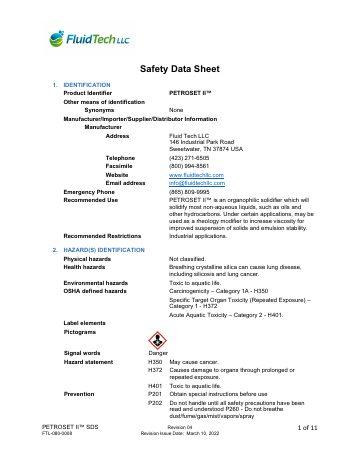
The linked PDF (Revision 4) is the authoritative document. The text below reproduces its contents for accessibility and reference. If anything differs, rely on the PDF, and confirm the revision date is current (within 3 years) before relying on this sheet.
1. Identification
- Product identifier
- PETROSET II™
- Synonyms
- None
- Recommended use
- PETROSET II™ is an organophilic solidifier which will solidify most non-aqueous liquids, such as oils and other hydrocarbons. Under certain applications, may be used as a rheology modifier to increase viscosity for improved suspension of solids and emulsion stability.
- Recommended restrictions
- Industrial applications.
- Manufacturer
- Fluid Tech LLC, 146 Industrial Park Road, Sweetwater, TN 37874, USA
- Telephone
- (423) 271-6505 · Fax (800) 994-8561
- Emergency phone
- (865) 809-9995
- Website / email
- www.fluidtechllc.com · info@fluidtechllc.com
2. Hazard(s) Identification
Signal word: Danger
Hazard classification: Carcinogenicity – Category 1A (H350); Specific Target Organ Toxicity, Repeated Exposure – Category 1 (H372); Acute Aquatic Toxicity – Category 2 (H401)
Hazard statements: H350 May cause cancer. H372 Causes damage to organs through prolonged or repeated exposure. H401 Toxic to aquatic life.
Other hazards
- Physical hazards
- Not classified.
- Health hazards
- Breathing crystalline silica can cause lung disease, including silicosis and lung cancer.
- Environmental hazards
- Toxic to aquatic life.
Precautionary statements
- Prevention
- P201 Obtain special instructions before use. P202 Do not handle until all safety precautions have been read and understood. P260 Do not breathe dust/fume/gas/mist/vapors/spray. P264 Wash face, hands and any exposed skin thoroughly after handling. P270 Do not eat, drink or smoke when using this product. P273 Avoid release to the environment. P280 Wear protective gloves/protective clothing/eye protection/face protection.
- Response
- P308 + P313 If exposed or concerned: Get medical advice/attention. P314 Get medical attention/advice if you feel unwell.
- Storage
- P405 Store locked up.
- Disposal
- P501 Dispose of contents/container in accordance with local/regional/national/international regulations.
- Hazard(s) not otherwise classified
- None known.
3. Composition / Information on Ingredients
| Substance | CAS number | Percent (w/w) | GHS classification (US) |
|---|---|---|---|
| Crystalline silica, quartz | 14808-60-7 | 1 – 5% | Carc. 1A (H350); STOT RE 1 (H372); Skin Irrit. 2 (H315) |
| Bis(hydrogenated tallow alkyl) methylamines | 61788-63-4 | 0.1 – 1% | Eye Irrit. 2 (H319); Aquatic Acute 1 (H400) |
4. First-Aid Measures
- Inhalation
- If inhaled, remove to fresh air. If not breathing give artificial respiration, preferably mouth-to-mouth. If breathing is difficult give oxygen. Get medical attention.
- Skin contact
- Wash off with soap and water. Get medical attention if irritation develops and persists.
- Eye contact
- In case of contact, immediately flush eyes with plenty of water for at least 15 minutes and get medical attention if irritation persists.
- Ingestion
- Do NOT induce vomiting. Give nothing by mouth. Obtain immediate medical attention.
- Most important symptoms/effects, acute and delayed
- Breathing crystalline silica can cause lung disease, including silicosis and lung cancer. Crystalline silica has also been associated with scleroderma and kidney disease.
- Immediate medical attention and special treatment needed
- Treat symptomatically.
- General information
- Ensure that medical personnel are aware of the material(s) involved and take precautions to protect themselves. IF exposed or concerned: Get medical advice/attention. No hazards which require special first aid measures.
5. Fire-Fighting Measures
- Suitable extinguishing media
- Water fog, carbon dioxide, foam, dry chemical.
- Unsuitable extinguishing media
- None known.
- Specific hazards arising from the chemical
- Decomposition in fire may produce harmful gases.
- Special protective equipment and precautions for firefighters
- Full protective clothing and approved self-contained breathing apparatus required for firefighting personnel.
6. Accidental Release Measures
- Personal precautions, protective equipment and emergency procedures
- Use only competent persons for cleanup. Ensure adequate ventilation. Avoid contact with skin, eyes and clothing. Do not breathe dust/fume/gas/mist/vapors/spray. Use appropriate protective equipment.
- Environmental precautions
- Prevent from entering sewers, waterways, or low areas.
- Methods and material for containment and cleaning up
- Collect using dustless method and hold for appropriate disposal. Consider possible toxic or fire hazards associated with contaminating substances and use appropriate methods for collection, storage and disposal. Cover powder spill with plastic sheet or tarp to minimize spreading.
7. Handling and Storage
- Precautions for safe handling
- Do not breathe dust/fume/gas/mist/vapors/spray. Ensure adequate ventilation. Use appropriate protective equipment. This product contains quartz, cristobalite, and/or tridymite which may become airborne without a visible cloud. Avoid breathing dust. Avoid creating dusty conditions. Use only with adequate ventilation to keep exposure below recommended exposure limits. Wear a NIOSH certified, European Standard EN 149, or equivalent respirator when using this product. Material is slippery when wet. Avoid contact with eyes, skin, or clothing.
- Conditions for safe storage, including any incompatibilities
- Product has a shelf life of 24 months. Store in a cool, dry location.
8. Exposure Controls / Personal Protection
| Substance | CAS number | OSHA PEL-TWA | ACGIH TLV-TWA |
|---|---|---|---|
| Crystalline silica, quartz | 14808-60-7 | TWA: 50 µg/m³ | TWA: 0.025 mg/m³ |
| Bis(hydrogenated tallow alkyl) methylamines | 61788-63-4 | Not applicable | Not applicable |
- Personal protective equipment
- If engineering controls and work practices cannot prevent excessive exposures, the selection and proper use of personal protective equipment should be determined by an industrial hygienist or other qualified professional based on the specific application of this product.
- Respiratory protection
- If engineering controls and work practices cannot keep exposure below occupational exposure limits or if exposure is unknown, wear a NIOSH certified, European Standard EN 149, AS/NZS 1715:2009, or equivalent respirator when using this product. Selection of and instruction on using all personal protective equipment, including respirators, should be performed by an Industrial Hygienist or other qualified professional. Dust/mist respirator. (N95, P2/P3)
- Hand protection
- Use gloves which are suitable for the chemicals present in this product as well as other environmental factors in the workplace.
- Skin protection
- Wear clothing appropriate for the work environment. Dusty clothing should be laundered before reuse. Use precautionary measures to avoid creating dust when removing or laundering clothing.
- Eye protection
- Safety glasses with side-shields. If splashes are likely to occur, wear: Goggles, Face-shield.
- Other precautions
- None known.
9. Physical and Chemical Properties
- Physical state
- Powder
- Color
- Tan
- Odor
- Mild
- Odor threshold
- No information available
- Specific gravity
- 1.6
- Water solubility
- Insoluble
pH, freezing/melting/boiling point, flash point, flammability (solid, gas), upper/lower flammability limits, evaporation rate, vapor pressure, vapor density, solubility in other solvents, partition coefficient (n-octanol/water), autoignition temperature, decomposition temperature, and viscosity: no data available. Explosive and oxidizing properties: no information available. See PDF for the complete property table.
10. Stability and Reactivity
- Reactivity
- Not expected to be reactive.
- Chemical stability
- Stable.
- Possibility of hazardous reactions
- Will not occur.
- Conditions to avoid
- None anticipated.
- Incompatible materials
- Strong oxidizers. Strong acids. Strong alkalis.
- Hazardous decomposition products
- Amorphous silica may transform at elevated temperatures to tridymite (870 °C) or cristobalite (1470 °C).
11. Toxicological Information
- Principal route of exposure
- Eye or skin contact, inhalation. Ingestion.
- Inhalation
- Inhaled crystalline silica in the form of quartz or cristobalite from occupational sources is carcinogenic to humans (IARC, Group 1). There is sufficient evidence in experimental animals for the carcinogenicity of tridymite (IARC, Group 2A). Breathing silica dust may cause irritation of the nose, throat, and respiratory passages. Breathing silica dust may not cause noticeable injury or illness even though permanent lung damage may be occurring. Inhalation of dust may also have serious chronic health effects.
- Eye contact
- May cause mechanical irritation to eye.
- Skin contact
- May cause mild skin irritation.
- Ingestion
- None known.
Chronic effects and carcinogenicity
Silicosis: Excessive inhalation of respirable crystalline silica dust may cause a progressive, disabling, and sometimes-fatal lung disease called silicosis. Symptoms include cough, shortness of breath, wheezing, non-specific chest illness, and reduced pulmonary function. This disease is exacerbated by smoking. Individuals with silicosis are predisposed to develop tuberculosis.
Cancer status: The International Agency for Research on Cancer (IARC) has determined that crystalline silica inhaled in the form of quartz or cristobalite from occupational sources can cause lung cancer in humans (Group 1 — carcinogenic to humans) and has determined that there is sufficient evidence in experimental animals for the carcinogenicity of tridymite (Group 2A — possible carcinogen to humans). The National Toxicology Program classifies respirable crystalline silica as "Known to be a human carcinogen." The American Conference of Governmental Industrial Hygienists (ACGIH) classifies crystalline silica, quartz, as a suspected human carcinogen (A2).
Full acute toxicity values (LD50/LC50), skin/eye irritation, sensitization, mutagenicity, reproductive toxicity, and STOT single/repeated exposure data for each component are provided in the PDF.
12. Ecological Information
- Ecotoxicity
- Harmful to aquatic life.
- Persistence and degradability
- Crystalline silica, quartz: The methods for determining biodegradability are not applicable to inorganic substances. Bis(hydrogenated tallow alkyl) methylamines: Readily biodegradable (100% @ 28d).
- Bioaccumulative potential
- No information available
- Mobility in soil
- No information available
- Other adverse effects
- No information available
Per-substance aquatic toxicity data (algae, fish, invertebrates) are provided in the PDF.
13. Disposal Considerations
- Disposal methods
- Disposal should be made in accordance with federal, state, and local regulations.
- Contaminated packaging
- Follow all applicable national or local regulations.
14. Transport Information
- Land (DOT)
- Not restricted.
- Land (TDG)
- Not restricted.
- Air (IATA / ICAO)
- Not restricted.
- Sea (IMDG / IMO)
- Not restricted.
- Transport in bulk (MARPOL 73/78 Annex 2.2 / IBC Code)
- Not applicable.
15. Regulatory Information
United States
- TSCA inventory
- All components listed on inventory or are exempt.
- TSCA Significant New Use Rules (S5A2)
- Not applicable (crystalline silica, quartz; bis(hydrogenated tallow alkyl) methylamines).
- SARA Title III Extremely Hazardous Substances
- Not applicable (both components).
- SARA (311, 312) hazard class
- Chronic Health Hazard.
- SARA (313) chemicals
- Not applicable — Toxic Release Inventory (TRI) Group I and Group II (both components).
- CERCLA / Superfund reportable spill quantity
- Not applicable (both components).
- RCRA hazardous waste
- If the product becomes a waste, it does NOT meet the criteria of a hazardous waste as defined by the US EPA.
- California Proposition 65
- Crystalline silica, quartz (14808-60-7): carcinogen. Bis(hydrogenated tallow alkyl) methylamines (61788-63-4): Not applicable.
- State Right-to-Know
- Crystalline silica, quartz — MA: Carcinogen; NJ: 1660; PA: Present. Bis(hydrogenated tallow alkyl) methylamines — MA: Extraordinarily hazardous; NJ: Not applicable; PA: Not applicable.
- NFPA ratings
- Health: 1 · Flammability: 0 · Reactivity: 0
- HMIS ratings
- Health: 1* · Flammability: 0 · Reactivity: 0
Canada
- DSL inventory
- All components listed on inventory or are exempt.
16. Other Information
- Issue date
- August 3, 2020
- Revision date
- March 10, 2022
- Version
- 04
- Further information
- For additional information on the use of this product, contact Fluid Tech LLC.
Revision history
- Revision 1 — 12 Ecological Information, 13 Disposal Considerations
- Revision 2 — 14 Transport Information and 15 Regulatory Information
- Revision 3 — Contact information
- Revision 4 — Addition of abbreviations and acronym information
Disclaimer
The information in this sheet was written based on the best knowledge and experience currently available. The information given within this SDS is correct to the best of our knowledge, information and belief at the date of its revision and publication. However, the manufacturer makes no representation, warranty or guarantee as to its accuracy, reliability or completeness, nor assumes any liability for its use. It is the user's responsibility to confirm in advance that the information is current, applicable and suitable to their circumstances for each particular use. No representative of ours has authority to waive this provision. Please call for document accuracy if the revision date has exceeded 3 years.