
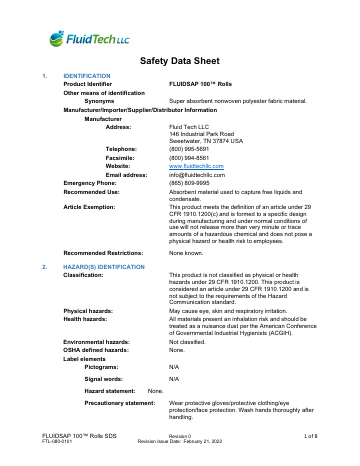
The linked PDF (Revision 0) is the authoritative document. The text below reproduces its contents for accessibility and reference. If anything differs, rely on the PDF, and confirm the revision date is current (within 3 years) before relying on this sheet.
1. Identification
- Product identifier
- FLUIDSAP 100® Rolls
- Synonyms
- Super absorbent nonwoven polyester fabric material.
- Recommended use
- Absorbent material used to capture free liquids and condensate.
- Article exemption
- This product meets the definition of an article under 29 CFR 1910.1200(c) and is formed to a specific design during manufacturing and under normal conditions of use will not release more than very minute or trace amounts of a hazardous chemical and does not pose a physical hazard or health risk to employees.
- Recommended restrictions
- None known.
- Manufacturer
- Fluid Tech LLC, 146 Industrial Park Road, Sweetwater, TN 37874, USA
- Telephone
- (423) 271-6505 · Fax (800) 994-8561
- Emergency phone
- (865) 809-9995
- Website / email
- www.fluidtechllc.com · info@fluidtechllc.com
2. Hazard(s) Identification
Signal word: None (N/A)
Classification: This product is not classified as physical or health hazards under 29 CFR 1910.1200. This product is considered an article under 29 CFR 1910.1200 and is not subject to the requirements of the Hazard Communication standard.
Hazard statement: None.
- Physical hazards
- May cause eye, skin and respiratory irritation.
- Health hazards
- All materials present an inhalation risk and should be treated as a nuisance dust per the American Conference of Governmental Industrial Hygienists (ACGIH).
- Environmental hazards
- Not classified.
- OSHA defined hazards
- None.
- Pictograms
- N/A
- Precautionary statement (label)
- Wear protective gloves/protective clothing/eye protection/face protection. Wash hands thoroughly after handling.
Precautionary statements
- Prevention
- None applicable.
- Response
- If exposed or concerned: Get medical advice/attention. This product is not combustible per NFPA. In case of fire, use appropriate media to extinguish.
- Storage
- Keep product in dry and sealed containers to avoid moisture uptake.
- Disposal
- Dispose of contents/container in accordance with local regulations.
- Hazard(s) not otherwise classified (HNOC)
- Material can be slippery when wet.
3. Composition / Information on Ingredients
| Chemical name | Common name and synonyms | CAS number | Percent |
|---|---|---|---|
| AQUA KEEP SA Superabsorbent Polymer / Sodium polyacrylate | Acrylic acid polymer, sodium salt | 9003-04-7 | 54.88% |
* This article contains these materials but under normal conditions of use, it would not present a physical hazard or health risk to individuals.
| Non-hazardous ingredients | Percent |
|---|---|
| Adhesive | 6.10% |
| WPT Polyester Nonwoven Fabric | 39.02% |
4. First-Aid Measures
- Inhalation
- Remove person to fresh air and keep comfortable for breathing. Call a Poison Control Center or doctor if you feel unwell.
- Skin contact
- If on skin, wash with plenty of water. If skin irritation occurs: Get medical advice/attention. Take off contaminated clothing and wash it before reuse.
- Eye contact
- If in eyes: Rinse cautiously with water for several minutes. Remove contact lenses, if present and easy to do. Continue rinsing. If eye irritation persists: Get medical advice/attention.
- Ingestion
- If swallowed: Call a Poison Control Center or doctor if you feel unwell. Rinse mouth. Do not induce vomiting.
- Most important symptoms/effects, acute and delayed
- No acute symptoms or effects. Prolonged contact may cause irritation.
- Immediate medical attention/special treatment
- If medical advice is needed, have the product container or label available.
5. Fire-Fighting Measures
- Suitable extinguishing media
- Super Absorbent Laminate does not pose a fire hazard, however normal fires can be extinguished using water mist, CO2, or Dry Chemical (AB, BC, ABC) extinguishers.
- Unsuitable extinguishing media
- None.
- Specific hazards arising from the chemical
- NONE. Although Super Absorbent Laminate poses no fire-related hazards, a self-contained breathing apparatus is recommended to limit exposure to combustion products when fighting any fire.
- Special protective equipment and precautions for firefighters
- Wear self-contained breathing apparatus with full-face mask and fire-fighter protective clothing when fighting fires.
- Unusual fire and explosion hazards
- None.
- General fire hazards
- None. (Health = 0, Flammability = 0, Reactivity = 0)
6. Accidental Release Measures
- Personal precautions
- Do not get in eyes, on skin, or on clothing.
- Protective equipment
- Wear appropriate personal protective equipment (PPE). If eye contact while using this product is anticipated, wear ANSI Z87 approved goggles or safety glasses. Consider using chemical resistant gloves (such as nitrile or neoprene) and protective clothing to minimize skin contact.
- Emergency procedures
- None
- Methods and materials for containment and cleanup
- Collect dry material using a scoop. Scrape up wet material and place in an appropriate container. Allow the material to dry before disposing. DO NOT attempt to wash Super Absorbent Laminate down drains.
- Environmental precautions
- No special environmental precautions required.
7. Handling and Storage
- Precautions for safe handling
- Handle in accordance with good industrial hygiene and safety procedures. Wash hands and other exposed areas with mild soap and water before eating, drinking, or smoking and before leaving work.
- Conditions for safe storage, including any incompatibilities
- Super Absorbent Laminate should be stored in a dry, cool and well-ventilated area. Incompatible materials include strong acids, strong bases, and strong oxidizers.
8. Exposure Controls / Personal Protection
| Component (CAS No.) | Percentage | OSHA PEL (8-Hr TWA) | ACGIH TLV | Other (NIOSH REL) |
|---|---|---|---|---|
| AQUA KEEP SA Superabsorbent Polymer, Acrylic Acid Polymer, Na Salt (9003-04-7) | 54.88 | 15 mg/m³ (T); 5 mg/m³ (R) | 10 mg/m³ (T); 5 mg/m³ (R) | 10 mg/m³ (T); 5 mg/m³ (R) (Nuisance dust) |
(T) = Total particulate · (R) = Respirable fraction · PNOR = Particulates not otherwise regulated
- Appropriate engineering controls
- Use sufficient local exhaust ventilation, or other engineering controls as necessary. General ventilation should be sufficient for most operations. Local exhaust ventilation may be necessary for some operations.
- Personal protective equipment
- To avoid exposures, wear ANSI-approved eye protection and chemical resistant gloves.
- Respiratory protection
- If it is not possible to reduce airborne exposure levels to below the OSHA PEL with ventilation, a NIOSH-approved air-purifying respirator with HEPA filters or a NIOSH-approved dust respirator should be used.
- Eye/face protection
- Under normal conditions, wear safety glasses with side shields or safety goggles that meet the ANSI Z87.1 standard.
- Hand protection
- Chemical-resistant gloves are recommended but not required.
- Protective clothing
- Wear long pants and long-sleeved shirts while working with this material. Consider wearing chemical protective clothing.
9. Physical and Chemical Properties
- Appearance
- White/off-white fabric
- Physical state
- Solid
- Form
- Fabric, absorbent granules are internally bonded.
- Odor
- Odorless
- Solubility (water)
- Insoluble
Odor threshold, pH, melting/freezing point, initial boiling point and boiling range, flash point, evaporation rate, flammability (solid, gas), upper/lower flammability and explosive limits, vapor pressure, vapor density, auto-ignition temperature, decomposition temperature, and viscosity: Not applicable. Relative density: Not available. See PDF for the complete property table.
10. Stability and Reactivity
- Reactivity
- The product is stable.
- Chemical stability
- Material is stable under normal conditions.
- Possibility of hazardous reactions
- No dangerous reaction known under conditions of normal use. Hazardous polymerization does not occur.
- Conditions to avoid
- Exposure to moisture. Direct sunlight. Extremely high or low temperatures. Avoid dispersal of dust in the air (i.e., clearing dust surfaces with compressed air). Minimize dust generation and accumulation.
- Incompatible materials
- Strong acids, strong bases, strong oxidizers.
- Hazardous decomposition products
- Will not spontaneously occur. Normal combustion products are carbon monoxide (CO) and carbon dioxide (CO2).
11. Toxicological Information
- Route(s) of entry
- Inhalation: Yes · Ingestion: Yes · Skin contact: Yes · Eye contact: Yes
- Symptoms related to the physical, chemical and toxicological characteristics
- May cause mild or severe irritation. Prolonged exposure can cause skin irritation.
- Delayed and immediate effects
- Exposure to airborne dust is not expected to present a significant inhalation hazard under anticipated conditions of use. Ingesting small quantities of dust is not expected to be harmful, however ill effects are possible if large quantities are consumed. Super Absorbent Laminate should not be eaten.
- Chronic effects from short-term and long-term exposure
- Prolonged exposure can cause skin irritation.
- LD50/LC50
- Acrylic Acid Polymer, Sodium Salt Oral LD50, Rat: > 2000 mg/kg
- Carcinogenicity
- NTP: No · IARC: No · OSHA: No
- Cancer
- None of the substances in these products is known or suspected of causing cancer.
- Mutagenicity
- Not classified.
- Neurotoxicity
- Not classified.
- Reproductive effects
- Not classified.
12. Ecological Information
- Ecotoxicity
- No recognized unusual toxicity to plants or animals. The product is not classified as environmentally hazardous.
- Persistence/degradability
- Stable under normal conditions.
- Bio-accumulative potential
- None.
- Mobility in soil
- Minimal to none.
- Other adverse effects
- No other adverse environmental effects.
13. Disposal Considerations
- Disposal instructions
- Do not discharge into waterways or sewer systems without proper authorization.
- Local disposal regulations
- Dispose in accordance with all applicable regulations.
- Waste from residues / unused products
- Empty containers or liners may retain some product residues. This material and its container must be disposed of in a safe manner (See: Disposal instructions). Dispose of in accordance with local regulations. Can be landfilled, when in compliance with local regulations.
- RCRA
- None listed.
14. Transport Information
- UN identification number
- Not applicable
- Proper shipping name
- Not applicable.
- Hazard class
- Not applicable.
- Secondary risk
- Not applicable.
- Packing group
- Not applicable.
- Label(s) required
- Not applicable.
- Environmental hazards (e.g., Marine pollutant)
- None.
- Transport in bulk (according to Annex II of MARPOL 73/78 and the IBC Code)
- Not applicable.
- Special precautions
- This material should be kept dry, and care should be taken to avoid releasing into streams, lakes or rivers.
15. Regulatory Information
United States
- SARA reporting requirements
- The components of this mixture are not subject to the reporting requirements of Sections 302, 304 and 313 of Title II of the Superfund Amendments and Reauthorization Act.
- SARA threshold planning quantity
- There are no specific Threshold Planning Quantities for the components of this product. The default Federal MSDS submission and inventory requirement filing threshold of 10,000 lbs. (4,540 kg) therefore applies, per 40 CFR 370.20.
- CERCLA Reportable Quantity (RQ)
- None
- TSCA inventory status
- Acrylic Acid Polymer, Sodium Salt, CAS# 9033-79-8 is listed on the TSCA inventory.
- TSCA significant new use rule
- None of the chemicals in this mixture have a SNUR under TSCA.
- Other U.S. federal regulations
- Not applicable.
- Clean Air Act
- This material does not contain any hazardous air pollutants. This material does not contain any Class 1 Ozone depletors. This material does not contain any Class 2 Ozone depletors.
- Clean Water Act
- None of the chemicals in this mixture are listed as Hazardous Substances under the CWA. None of the chemicals in this mixture are listed as Priority Pollutants under the CWA. None of the chemicals in this mixture are listed as Toxic Pollutants under the CWA.
- OSHA
- None of the chemicals in this mixture are considered highly hazardous by OSHA.
- California Proposition 65
- None of the chemicals in this product are listed.
Other state-specific regulations
- Massachusetts Right to Know Act
- None of the chemicals in this product are listed on the RTK list.
- Pennsylvania Worker and Community Right to Know Act
- Cellulose, CAS# 9004-34-06 is a hazardous substance under the Act but it is not a special hazardous substance or an environmental hazardous substance.
- New Jersey Worker and Community Right to Know Act
- None of the chemicals in this product are listed on the RTK list.
16. Other Information
- Issue date
- February 21, 2022
- Revision date
- None
- Version
- 0
Further information
The information in the sheet is presented in good faith and written based on the best knowledge and experience currently available in regard to the product and current legal requirements and standards.
Disclaimer
Manufacturer makes no representation, warranty or guarantee as to its accuracy, reliability or completeness, nor assumes any liability for its use. It is the user's responsibility to confirm in advance that the information is current, applicable and suitable to their circumstances for each particular use. No representative of ours has authority to waive this provision. Please call for document accuracy if the revision date has exceeded 3 years.