
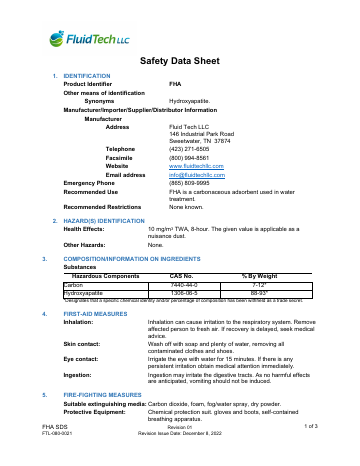
The linked PDF (Revision 01) is the authoritative document. The text below reproduces its contents for accessibility and reference. If anything differs, rely on the PDF, and confirm the revision date is current (within 3 years) before relying on this sheet.
1. Identification
- Product identifier
- FHA™
- Synonyms
- Hydroxyapatite
- Recommended use
- FHA™ is a carbonaceous adsorbent used in water treatment.
- Recommended restrictions
- None known.
- Manufacturer
- Fluid Tech LLC, 146 Industrial Park Road, Sweetwater, TN 37874, USA
- Telephone
- (423) 271-6505 · Fax (800) 994-8561
- Emergency phone
- (865) 809-9995
- Website / email
- www.fluidtechllc.com · info@fluidtechllc.com
2. Hazard(s) Identification
Signal word: None assigned
Health effects: 10 mg/m³ TWA, 8-hour. The given value is applicable as a nuisance dust.
Other hazards: None.
3. Composition / Information on Ingredients
| Hazardous component | CAS number | % by weight |
|---|---|---|
| Carbon | 7440-44-0 | 7–12%* |
| Hydroxyapatite | 1306-06-5 | 88–93%* |
* Designates that a specific chemical identity and/or percentage of composition has been withheld as a trade secret.
4. First-Aid Measures
- Inhalation
- Inhalation can cause irritation to the respiratory system. Remove affected person to fresh air. If recovery is delayed, seek medical advice.
- Skin contact
- Wash off with soap and plenty of water, removing all contaminated clothes and shoes.
- Eye contact
- Irrigate the eye with water for 15 minutes. If there is any persistent irritation obtain medical attention immediately.
- Ingestion
- Ingestion may irritate the digestive tracts. As no harmful effects are anticipated, vomiting should not be induced.
5. Fire-Fighting Measures
- Suitable extinguishing media
- Carbon dioxide, foam, fog/water spray, dry powder.
- Protective equipment
- Chemical protection suit, gloves and boots, self-contained breathing apparatus.
- Specific hazards
- Nonflammable in bulk. Will smolder if ignited. Risk of carbon monoxide formation where air circulation is restricted.
6. Accidental Release Measures
- Personal precautions
- Use personal protective clothing. (See item 8).
- Environmental precautions
- Dispose of within local or national regulations.
- Methods for cleaning up
- Sweep or shovel into suitable container for disposal.
7. Handling and Storage
- Handling precautions
- Maintain good working practices while handling. Remove contaminated clothing and wash before reuse.
- Storage conditions
- Minimize dust formation. Keep dry. Keep away from strong oxidizing agents and strong acids.
8. Exposure Controls / Personal Protection
| Substance | Exposure limit (TWA, 8-hour) |
|---|---|
| Product (as nuisance dust) | 10 mg/m³ |
The given value is applicable as a nuisance dust.
- Engineering measures
- May contain trace quantities of ammonia which can be released during initial washing. Ensure adequate ventilation. In confined…
- Eye/face protection
- Wear tight fitting safety goggles.
- Skin protection
- Suitable gloves. Lightweight protective clothing.
- Respiratory protection
- Wear suitable dust mask.
- General hygiene considerations
- Do not breathe dust. When using, do not eat, drink or smoke. Avoid contact with eyes. Always observe good personal hygiene measures, such as washing after handling the material and before eating, drinking, and/or smoking. Routinely wash work clothing and protective equipment to remove contaminants.
9. Physical and Chemical Properties
- Physical state
- Granular or powdered solid
- Color
- Black
- Odor
- Non-specific
- pH
- 8.5 – 12 @ 25 °C
- Explosive properties
- Class B – non-explosive
- Bulk density
- 560 – 720 kg/m³
- Solubility (water)
- Insoluble
Odor threshold, melting/freezing point, initial boiling point and boiling range, flash point, evaporation rate, oxidizing properties, and vapor pressure: not applicable. Flammability (solid, gas) and auto-ignition temperature: not determined. See PDF for the complete property table.
10. Stability and Reactivity
- Stability
- Stable at ambient temperatures.
- Conditions to avoid
- Keep away from heat and sources of ignition.
- Incompatible materials
- Reactive chemicals, especially oxidizing agents.
- Hazardous decomposition products
- Thermal decomposition can lead to the release of carbon dioxide, and a little hydrogen sulfide may be given off on reaction with mineral acids.
11. Toxicological Information
None.
12. Ecological Information
None.
13. Disposal Considerations
All federal, state, and local regulations should be followed.
14. Transport Information
- Classification
- Not classified as a dangerous material. Not DOT regulated.
15. Regulatory Information
- Marking and labelling symbol
- None.
- Risk phrases
- R36 – Irritating to eyes. R37 – Irritating to respiratory system. R38 – Irritating to skin.
- Safety phrases
- S36, S37/S39
16. Other Information
- Issue date
- December 8, 2022
- Revision date
- Not applicable.
- Version
- 01
- Further information
- None.
- Revision info
- Not applicable.
Disclaimer
The information given within this SDS is correct to the best of our knowledge, information, and belief at the date of its revision and publication. However, the manufacturer makes no representation, warranty or guarantee as to its accuracy, reliability or completeness, nor assumes any liability for its use. It is the user's responsibility to confirm in advance that the information is current, applicable and suitable to their circumstances for each particular use. No representative of ours has authority to waive this provision. Please call for document accuracy if the revision date has exceeded 3 years.